
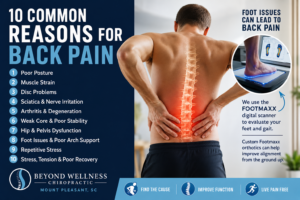
10 Common Reasons for Back Pain
Back pain is one of the most common problems we see at Beyond Wellness Chiropractic in Mount Pleasant, SC. Some people come in after one specific injury, like lifting something too heavy, twisting wrong, or waking up with a back that suddenly “locked up.” Other people have the kind of back pain that slowly builds over time. It may start as stiffness in the morning, a dull ache after sitting too long, or tightness that keeps coming back no matter how much they stretch.
The frustrating part is that back pain does not always have one simple cause. The area that hurts may not be the only area involved. A low back problem may involve the hips. A hip problem may be affected by the feet. A posture problem may involve the neck, shoulders, mid back, and pelvis. That is why we do not like to guess. We look at how the spine, pelvis, muscles, posture, gait, and movement patterns are working together.
According to the CDC, 39.0% of U.S. adults reported back pain in the previous 3 months in 2019. Source: CDC — Back, Lower Limb, and Upper Limb Pain Among U.S. Adults.
The National Institute of Arthritis and Musculoskeletal and Skin Diseases explains that back pain can involve mechanical or structural problems in the spine, discs, muscles, ligaments, tendons, or nerves. Source: NIAMS — Back Pain Symptoms, Types, and Causes.
Below are 10 common reasons people develop back pain. This is not meant to diagnose your specific condition online, but it can help you understand why a proper chiropractic evaluation matters.
1. Poor Posture From Sitting, Driving, and Phone Use
One of the most common patterns we see is posture-related back pain. A lot of people think posture only means “standing up straight,” but posture is really how your body handles stress all day long.
If you sit at a computer, drive for long periods, look down at your phone, or work in a forward-bent position, your spine has to adapt. The head shifts forward, the shoulders round, the mid back stiffens, and the low back often loses its natural support. Over time, muscles tighten in some areas and weaken in others. The spine may stop moving evenly, and the body starts to compensate.
Posture-related back pain often feels worse after sitting or standing still. You may feel stiff when getting up from a chair, tight across the low back, or sore between the shoulder blades. Some people also notice headaches, neck tension, or hip tightness along with their back pain.
At Beyond Wellness Chiropractic, we look at posture from the side, front, and back. We also ask about work setup, driving, sleeping position, and daily habits. The goal is not to simply tell someone to “sit up straight.” The goal is to find out why the body keeps falling into the same stressful position and what can be done to improve it.
2. Muscle Strain From Lifting, Twisting, or Overdoing It
Muscle strains are a very common reason for sudden back pain. This can happen from lifting furniture, carrying groceries, doing yard work, exercising, moving the wrong way, or twisting while holding weight. Sometimes it happens during something that seems minor, like bending over to pick up a shoe.
When a muscle strain occurs, the body often protects the area by tightening up. That protective tightness can feel like a spasm. Many patients describe it as a grabbing, stabbing, or locking sensation. They may have trouble standing upright, rolling in bed, or getting in and out of the car.
The important thing is that the muscle is not always the only issue. Muscles often tighten because a joint is irritated, the pelvis is not moving well, or the body is trying to protect a deeper problem. If we only focus on the tight muscle and ignore the mechanics behind it, the same pain may keep coming back.
Chiropractic care may help by restoring better joint motion, reducing irritation, and helping the body move normally again. Once the pain calms down, we often give simple movement advice so the patient does not keep re-injuring the same area.
3. Disc Irritation or Disc Injury
Spinal discs sit between the bones of the spine and help absorb shock. When a disc becomes irritated, bulges, herniates, or degenerates, it may cause back pain. If the disc irritates a nearby nerve, symptoms can travel into the buttock, hip, thigh, calf, or foot.
Disc-related pain can feel different from ordinary muscle soreness. Some people feel deep low back pressure. Others feel sharp pain with bending, sitting, coughing, sneezing, or lifting. Some feel leg pain more than back pain. Numbness, tingling, burning, or weakness can also happen when nerve tissue is involved.
Not every disc finding on an MRI is the cause of pain, and not every case of back pain is a disc problem. That is why an exam matters. We look at posture, movement, neurological signs, orthopedic testing, and how symptoms behave with different positions.
When disc irritation appears to be mechanical and appropriate for chiropractic care, the treatment plan may include gentle adjustments, flexion-distraction, decompression-style positioning, movement modification, and specific home instructions. The goal is to reduce irritation, improve motion, and help the patient avoid positions that keep aggravating the disc.
4. Sciatica and Nerve Irritation
Sciatica is one of the most common terms patients use when pain travels from the low back or buttock down the leg. True sciatic-type pain may feel sharp, burning, electric, deep, or achy. It may travel into the hamstring, calf, or foot. Some people also notice numbness, tingling, or weakness.
Sciatica is not the actual cause. It is a symptom pattern. The real question is: what is irritating the nerve?
Possible causes include disc irritation, joint restriction in the low back or pelvis, inflammation around nerve tissue, muscle tension around the hip, spinal stenosis, or other mechanical problems. Because several issues can create similar symptoms, it is not smart to assume every leg pain case is the same.
During a chiropractic evaluation, we check how the low back, pelvis, hips, and legs are moving. We also look for red flags. Severe or progressive weakness, loss of bladder or bowel control, fever, unexplained weight loss, major trauma, or rapidly worsening symptoms need medical attention.
For many mechanical cases of sciatic-type pain, chiropractic care can be part of a conservative plan. The key is identifying what is irritating the nerve and reducing the stress that keeps feeding the problem.
5. Arthritis and Spinal Degeneration
Arthritis and degenerative changes are common as people age, but they do not affect everyone the same way. One person may have significant arthritis on an X-ray and very little pain. Another person may have mild imaging findings but a lot of stiffness and discomfort.
Degeneration can involve the spinal joints, discs, ligaments, or the spaces where nerves exit the spine. It may cause stiffness, limited motion, aching, or pain that is worse after certain activities. Some people feel stiff first thing in the morning. Others feel worse after standing or walking too long.
The goal of chiropractic care is not to “erase” arthritis. The goal is to help the spine move as well as possible, reduce unnecessary stress on irritated joints, and improve function. Even when structural changes are present, better movement can often make a meaningful difference in how someone feels and functions.
Patients with degenerative back pain often benefit from a combination of chiropractic adjustments, mobility work, strengthening, posture changes, better walking habits, and sometimes better foot support. Small improvements in movement can reduce the daily stress placed on the spine.
6. Weak Core Muscles and Poor Spinal Stability
Many people hear “core strength” and think of sit-ups or six-pack abs. That is not what we mean when we talk about spinal stability. Your core includes the deep stabilizing muscles of the spine, pelvis, hips, abdomen, and diaphragm. These muscles help control movement and protect the low back during daily activity.
A person can be strong in the gym and still have poor core control. The problem is not always raw strength. Sometimes it is timing, coordination, breathing, hip control, or the way the body handles load.
When the core is not supporting the spine well, the low back often takes over. This can lead to recurring episodes where the back “goes out.” A patient may feel better after care, then flare up again because the same unstable movement pattern is still there.
That is why we often pair chiropractic care with simple corrective exercises. The adjustment may help restore motion and reduce irritation, while the exercises help the body hold better mechanics. Depending on the patient, this may include breathing drills, glute activation, hip mobility, pelvic control, and progressive core stabilization.
The right exercise matters. A generic routine from the internet may not match what your body needs. Some people need more mobility. Others need more stability. Some need to stop doing exercises that are actually irritating their back.
7. Hip and Pelvis Problems
The low back and pelvis work together. If the hips are stiff, the pelvis is not moving well, or the sacroiliac joints are irritated, the low back often compensates.
This is common in people who sit a lot, drive frequently, play golf, work out, run, stand for long hours, or have one-sided movement habits. A golfer may rotate better one way than the other. A driver may sit with one hip higher. A parent may always carry a child on the same side. Over time, these patterns can show up as back pain.
Hip-related back pain may feel like low back pain, buttock pain, or pain near the back of the pelvis. It may be worse with stairs, getting out of a car, standing on one leg, rolling over in bed, or standing after sitting.
During an exam, we look at hip motion, pelvic alignment, spinal motion, muscle tension, and functional movement. Many patients are surprised to learn that the area that hurts is not always the area that started the problem.
Improving hip and pelvic mechanics can reduce stress on the low back. Treatment may include chiropractic adjustments, stretching, strengthening, soft tissue work, posture advice, and better movement habits.
8. Foot Issues, Poor Arch Support, and Abnormal Gait
This is one of the most overlooked causes of recurring back pain. Your feet are the foundation for your entire body. Every time you stand, walk, run, lift, or climb stairs, force travels from the ground through your feet, knees, hips, pelvis, and spine.
If your feet are not supporting you well, the body may compensate above. Collapsed arches, overpronation, uneven pressure, poor shoe support, or abnormal gait mechanics can affect how the knees and hips move. That can change the stress placed on the pelvis and low back.
This does not mean every case of back pain starts in the feet. It does mean the feet should be checked when back pain keeps returning, especially if you stand all day, walk on hard floors, have knee or hip pain, wear out shoes unevenly, or feel better in certain shoes than others.
At Beyond Wellness Chiropractic in Mount Pleasant, we use a Footmaxx digital scanner to evaluate foot mechanics. Footmaxx describes its technology as advanced 3D scanning and gait analysis for custom orthotics. Source: Footmaxx Technology.
Footmaxx also offers custom orthotics designed around the patient’s scan and prescription needs. Source: Footmaxx Custom Orthotics.
We consider Footmaxx a high-level orthotic system because it gives us digital information that is much more detailed than simply looking at the foot or guessing based on shoe wear. The scanner helps us evaluate how the feet are loading and whether custom orthotics may be appropriate.
Orthotics are not a cure-all for back pain, and they are not necessary for every patient. But when foot mechanics are part of the problem, custom orthotics can be an important piece of the plan. The best results usually come when foot support is combined with chiropractic care, posture correction, hip and core work, and better movement habits.
9. Repetitive Stress From Work, Sports, or Daily Habits
Back pain often develops from repeated stress rather than one major injury. This is very common in real life. People bend, twist, lift, sit, stand, drive, carry, reach, and lean all day long. If the same pattern is repeated long enough, the body eventually complains.
Someone who works at a computer may develop stiffness from sitting. A contractor may overload the back from lifting and bending. A nurse or caregiver may strain the spine while helping patients. A golfer may rotate through the same pattern repeatedly. A parent may constantly lift a child from one side. A hairstylist may stand on hard floors all day.
At first, the body adapts. Then it compensates. Eventually, the compensation becomes pain.
This is why we ask detailed questions. Where do you work? How long do you sit? What kind of shoes do you wear? Do you drive a lot? Do you sleep on your stomach? Do you lift with a twist? Does your pain feel better on weekends or worse after certain activities?
These details matter. Chiropractic care can help improve motion and reduce irritation, but if the same daily stress keeps feeding the problem, the pain may return. A good plan should address both the spine and the habits that are stressing it.
10. Stress, Tension, and Poor Recovery
Stress can absolutely show up in the back. That does not mean the pain is imaginary. It means the nervous system, muscles, posture, breathing, sleep, and recovery are all connected.
When people are under stress, they often hold tension in the shoulders, neck, mid back, and low back. Breathing may become shallow. Sleep may get worse. The body may stay guarded. Muscles do not relax well, and the nervous system becomes more sensitive.
Poor recovery also matters. If you are sleeping poorly, sitting too much, dehydrated, inactive, or constantly tense, your body has less ability to heal and adapt. That can make a small back problem feel much bigger.
A complete back pain plan should look at the mechanical side and the recovery side. Chiropractic care may help improve motion and reduce irritation, but walking, hydration, breathing, better sleep habits, stretching, and stress management can also make a difference.
Sometimes the biggest improvement comes from combining small changes. A better pillow, more walking, less sitting, improved spinal motion, better foot support, and a simple strengthening plan may work together better than any one thing alone.
How We Evaluate Back Pain at Beyond Wellness Chiropractic
When someone comes into our Mount Pleasant chiropractic office with back pain, we do not want to simply chase the painful spot. We want to understand why the area became irritated in the first place.
Depending on the case, we may evaluate:
- Spinal motion
- Posture
- Pelvic and hip movement
- Muscle tightness and weakness
- Nerve irritation signs
- Daily habits and work stress
- Foot mechanics and gait
- Shoe wear patterns
- Whether Footmaxx custom orthotics may be appropriate
Some patients need chiropractic adjustments. Some need stretching. Some need strengthening. Some need better foot support. Some need changes in how they sit, sleep, work, or lift. Most people need a combination.
The goal is not just temporary relief. The goal is to help you move better, function better, and understand what your body needs so the same pain does not keep returning.
When Should You Get Back Pain Checked?
You should consider getting your back pain evaluated if it lasts more than a few days, keeps coming back, travels into the hip or leg, causes numbness or tingling, affects your sleep, or limits your normal activities.
You should seek urgent medical care if back pain is associated with loss of bladder or bowel control, severe or progressive weakness, fever, major trauma, unexplained weight loss, or rapidly worsening symptoms.
Many people wait until the pain is severe before they do anything. In our experience, it is better to address back pain early, before the body builds more compensation around it.
Back Pain Chiropractor in Mount Pleasant, SC
If you are dealing with low back pain, sciatica, stiffness, posture problems, disc-related symptoms, hip tightness, or recurring back pain, Beyond Wellness Chiropractic can help you take the next step.
We look at the spine, posture, hips, pelvis, movement patterns, and feet. We also offer Footmaxx digital scanning and can order custom Footmaxx orthotics when foot mechanics appear to be part of the problem.
Back pain is common, but it should not be ignored. Pain is often the body’s way of telling you that something is not moving, supporting, or functioning the way it should.
Relief is temporary. Wellness is a lifestyle.
If you are ready to find out what may be causing your back pain, schedule an evaluation with Beyond Wellness Chiropractic in Mount Pleasant, SC.
Schedule an appointment with Beyond Wellness Chiropractic
Frequently Asked Questions About Back Pain
What is the most common cause of back pain?
Back pain is often mechanical, meaning it involves the joints, muscles, discs, ligaments, tendons, or nerves. Poor posture, muscle strain, joint restriction, disc irritation, and repetitive stress are all common contributors.
Can my feet cause low back pain?
Foot problems can contribute to low back pain in some people. If the arches collapse, the feet overpronate, or weight is not distributed evenly, stress can travel up through the knees, hips, pelvis, and spine.
What does the Footmaxx scanner do?
The Footmaxx digital scanner helps evaluate foot mechanics and gait-related patterns. This information can help determine whether custom orthotics may be appropriate as part of a larger chiropractic care plan.
Are custom orthotics good for back pain?
Custom orthotics may help some people with back pain, especially when poor foot mechanics, uneven pressure, or abnormal gait patterns are contributing to stress through the pelvis and low back. They are not needed for every patient, but they can be very helpful in the right case.
Should I see a chiropractor if my back pain keeps coming back?
Yes, recurring back pain should be evaluated. Pain that keeps returning often means there is an underlying movement, posture, joint, muscle, hip, pelvic, or foot issue that has not been fully addressed.
